Welcome!

I am Mrs.Joreena Leosamraj a Teacher a Chemist

View question papers Hire us

About the developer

Programming
Developing
Who am i

Mrs.Joreena Leosamraj

Teacher

Hey everyone i am Mrs.Joreena Leosamraj..I am a teacher working in seventh-day Adventist English school tambaram..I teach science for the students and also teach chemistry for the 10th ICSE students..I have sponsered this site for the Class 10th students to learn fast for their forth comming exams..

I studied in St. Theresa girls higher secondary school, Pallavaram. My chemistry teacher Mrs Lilly Christina is my inspiration to choose this subject

Services

Web Design

I designed and developed lots of web for myself and for socialy

Development

I developed bunch of apps and games but not yet publish in playstore

Java sessions

I use to take java sessions in zoom for complete beginners at low price

Prices

Java session for complete beginners : $5 App and web development : $3 Java sessions for advanced programming : $20

Chemistry question papers

ICSE Chemistry Question Paper 2010 Solved for Class 10

 ICSE Paper 2010

CHEMISTRY

(Two Hours)
Answers to this Paper must be written on the paper provided separately.
You will not be allowed to write during the first 15 minutes.
This time is to be spent in reading the Question Paper.
The time given at the head of this Paper is the time allowed for writing the answers.
Section I is compulsory. Attempt any four questions from Section II.
The intended marks for questions or parts of questions are given in brackets [ ].

SECTION-I  (40 Marks)
(Attempt all questions from this Section)

Question 1:
(a) From the list given below, select the word(s) required to correctly complete the blanks (1) to (5) in the following passage:
Note: words chosen from the list are to be used only once. Write only the answers. Do not copy the passage.
[reddish brown, ammonium, nitrogen dioxide, hydroxyl, dirty green, ammonia, acidic, alkaline]
Nitrogen and hydrogen combine in the presence of a catalyst to give (1) ………… gas. When the above mentioned gas is passed through water it forms a solution which will be (2) ………….. in nature and the solution contains (3) …………. ions and (4) ………….. ions. The above solution when added to iron(II) sulphate solution, give a (5) …………… coloured precipitate of iron(II) hydroxide. [5]

(b) Select from the list given (A to E) one substance in each case which matches the description given in parts (1) to (5). (Note: Each substance is used only once in the answer.)
(A) Nitroso Iron(II) sulphate (B) Iron(III) chloride (C) Chromium sulphate (D) Lead(II) chloride (E) Sodium chloride.

  1. A compound which is deliquescent.
  2. A compound which is insoluble in cold water, but soluble in hot water.
  3. The compound responsible for the brown ring during the brown ring test of nitrate ion.
  4. A compound whose aqueous solution is neutral in nature.
  5. The compound which is responsible for the green coloration when sulphur dioxide is passed through acidified potassium dichromate solution. ** [5]
    ** Answer has not given due to out of present syllabus.

(c) For part (c). 1 – (c). 10, select the correct answer from the choices A, B, C and D which are given.
Write only the letter corresponding to the correct answer. [10]

  1. A particular solution contains molecules and ions of the solute so it is a:
    (A) weak acid         (B) strong acid
    (C) strong base      (D) salt solution
  2. A compound which liberates reddish brown gas around the anode during electrolysis in its molten state is:
    (A) Sodium chloride            (B) Copper(II) oxide
    (C) Copper(II) sulphate      (D) Lead(II) bromide
  3. An organic compound undergoes addition reactions and gives a red colour precipitate with ammoniacal cuprous chloride. Therefore, the organic compound could be:
    (A) Ethane         (B) Ethene
    (C) Ethyne         (D) Ethanol
  4. An organic weak acid is:
    (A) Formic acid         (B) Sulphuric acid
    (C) Nitric acid            (D) Hydrochloric acid
  5. During ionization metals lose electrons, this change can be called:
    (A) Oxidation        (B) Reduction
    (C) Redox               (D) Displacement
  6. Which one of the following is not true of metals:
    (A) Metals are good conductors of electricity
    (B) Metals are malleable and ductile
    (C) Metals from non-polar covalent compounds
    (D) Metal will have 1 or 2 or 3 electrons in their valence shell.
  7. An example of a complex salt is:
    (A) Zinc sulphate
    (B) Sodium hydrogensulphate
    (C) Iron(II) ammonium sulphate
    (D) Tetrammine copper(II) sulphate
  8. Aqua regia is a mixture of:
    (A) Dilute hydrochloric acid and concentrated nitric acid
    (B) Concentrated hydrochloric acid and dilute nitric acid
    (C) Concentrated hydrochloric acid [1 partj and concentrated nitric acid [3 parts]
    (D) Concentrated hydrochloric acid [3 parts] and concentrated nitric acid [1 part]
  9. The organic compound mixed with ethanol to make it spurious is:
    (A) Methanol       (B) Methanoic acid
    (C) Methanal       (D) Ethanoic acid
  10. The number of electrons present in the valence shell of a halogen is:
    (A) 1         (B) 3
    (C) 5         (D) 7

(d) State your observation for the following cases: [5]

  1. Moist blue litmus is introduced into a gas jar of sulphur dioxide. **
  2. Dry red rose petals are placed in the jar of sulphur dioxide. **
  3. Paper soaked in potassium permanganate solution is introduced into a gas jar of sulphur dioxide. **
  4. Ammonia gas is burnt in an atmosphere of oxygen in the absence of a catalyst.
  5. Glass rod dipped in ammonium hydroxide is brought near the mouth of the concentrated hydrochloric acid bottle.
    ** Answer has not given due to out of present syllabus.

(e) Match the column A with column B. [5]

Column AColumn B
1. Sodium chlorideIncreases
2. Ammonium ionCovalent bond
3. Electronegativity across the periodIonic bond
4. Non metallic character down the groupCovalent and Coordinate bond
5. Carbon tetrachlorideDecreases

Answer as follows:
(i) correct item from B matching sodium chloride.
(ii) correct item from B matching ammonium ion, and so on.

(f) Write the equation for each of the following reactions: [5]

(i) Sulphur is heated with concentrated sulphuric acid.
(ii) Zinc oxide is treated with sodium hydroxide solution.


(iii) Ammonium chloride is heated with sodium hydroxide.
(iv) Concentrated sulphuric acid is poured over sugar.
(v) Magnesium sulphate solution is mixed with barium chloride solution.

(g) (i) LPG stands for liquefied petroleum gas. Varieties of LPG are marketed including a mixture of propane (60%) and butane (40%). If 10 litre of this mixture is burnt, find the total volume of carbon dioxide gas added to the atmosphere. Combustion reactions can be represented as: [5]

ICSE Chemistry Question Paper 2010 Solved for Class 10 - 1
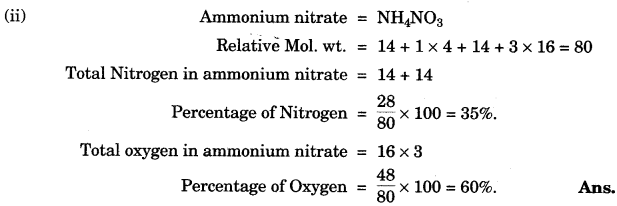
(ii) Calculate the percentage of nitrogen and oxygen in ammonium nitrate. [Relative molecular mass of ammonium nitrate is 80, [H = 1, N = 14, O = 16]

Answer:
(a)

  1. Ammonia
  2. Alkaline
  3. Ammonium
  4. Hydroxyl
  5. Dirty green.

(b)

  1. (B) Iron(III) chloride
  2. (D) Lead(II) chloride
  3. (A) Nitroso Iron(II) sulphate
  4. (E) Sodium chloride

(c)

  1. (A)
  2. (D)
  3. (C)
  4. (A)
  5. (A)
  6. (C)
  7. (D)
  8. (D)
  9. (A)
  10. (D)

(d)

4. It burns with a yellowish green flame producing water vapour and nitrogen.
5.  It produce dense white fumes of ammonium chloride.

(e)

  1. Sodium chloride – Ionic bond.
  2. Ammonium ion – Covalent and Co-ordinate bond.
  3. Electronegativity across a period – Increases.
  4. Non metallic character down the group – Decreases.
  5. Carbon tetrachloride – Covalent bond.

(f)
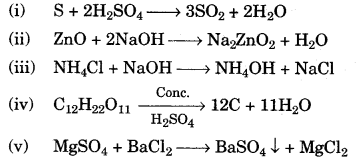
ICSE Chemistry Question Paper 2010 Solved for Class 10 - 2

(g)

ICSE Chemistry Question Paper 2010 Solved for Class 10 - 3
ICSE Chemistry Question Paper 2010 Solved for Class 10 - 4

SECTION-II (40 Marks)
(Answer any four questions from this section)

Question 2:
(a) Given the equations for the following conversions A to E.
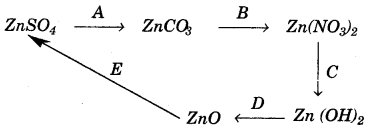
ICSE Chemistry Question Paper 2010 Solved for Class 10 - 5
(b) The questions below are related to the manufacture of ammonia:

(i) Name the process.
(ii) In what ratio must the reactants be taken?
(iii) Name the catalyst used.
(iv) Give the equation for the manufacture of ammonia.
(v) Ammonia can act as a reducing agent – write a relevant equation for such a reaction.    [5]

Answer:
(a)
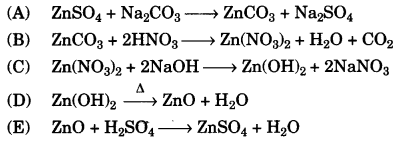
ICSE Chemistry Question Paper 2010 Solved for Class 10 - 6

(b)

(i) Haber’s process.
(ii) 1 part of nitrogen gas and 3 parts of hydrogen gas.
(iii) Finely divided iron (Fe).
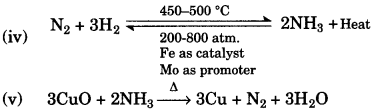
ICSE Chemistry Question Paper 2010 Solved for Class 10 - 7

Question 3:
(a) Draw the structural formula for each of the following:
(i) Ethanoic acid        (ii) But-2-yne.          [2]

(b) Mr. Ramu wants to electroplate his key chain with nickel to prevent rusting. For this electroplating:

(i) Name the electrolyte
(ii) Name the cathode
(iii) Name the anode
(iv) Give the reaction at the cathode
(v) Give the reaction at the anode.      [5]

(c) Three different electrolytic cells A, B and C are connected in separate circuits. Electrolytic cell A contains sodium chloride solution. When the circuit is complete a bulb in the circuit glows brightly. Electrolytic cell B contains acetic acid solution and in this case the bulb in the circuit glows dimly. The electrolytic cell C contains sugar solution and the bulb does not glow. Give a reason for each of these observations. [5]

Answer:
(a)
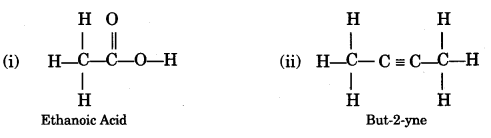
ICSE Chemistry Question Paper 2010 Solved for Class 10 - 8

(b)

(i) Aqueous solution of Nickel Sulphate with few drops of dil. Sulphuric acid.
(ii) The key chain.
(iii) Pure Nickel bar.
(iv) Ni++ + 2e    →   Ni
(v) Ni – 2e   →   Ni++

(c)

A is sodium chloride solution which is a strong electrolyte which contains only ions. So more electricity is conducted and bulb glows brightly.
B is acetic acid which contains both ions and molecules that is less number of ions. So less electricity is conducted and bulb glows dimly.
C is sugar solution which is a non electrolyte that is it does not contain ions so electricity is not conducted and bulb does not glow.

Question 4:
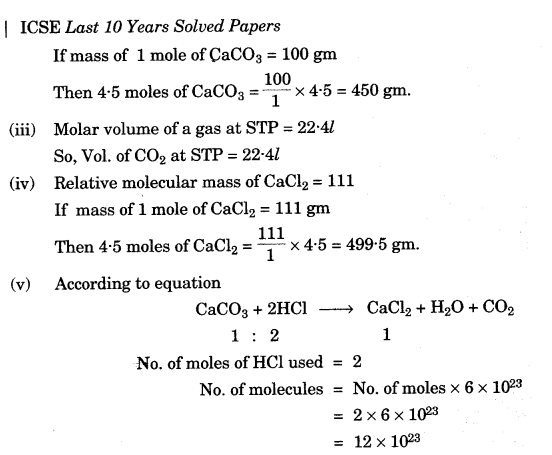
(a) 4.5 moles of calcium carbonate are reached with dilute hydrochloric acid.

(i) Write the equations for the reaction.
(ii) What is the mass of 4.5 moles of calcium carbonate? (Relative molecular mass of calcium carbonate is 100).
(iii) What is the volume of carbon dioxide liberated at stp?
(iv) What mass of calcium chloride is formed? (Relative molecular mass of calcium chloride is 111).
(v) How many moles of HCl are used in this reaction?           [5]

(b) The diagram shows an apparatus for the laboratory preparation of hydrogen chloride.
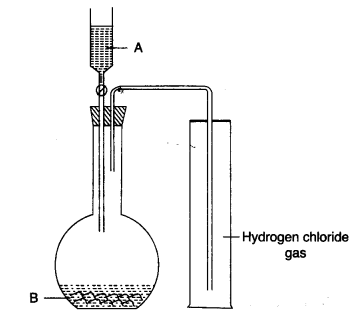
ICSE Chemistry Question Paper 2010 Solved for Class 10 - 9
(i)
 Identify A and B.
(ii) Write the equation for the reaction.
(iii) How would you check whether or not the gas jar is filled with hydrogen chloride?
(iv) What does the method of collection tell you about the density of hydrogen chloride? [5]

Answer:
(a)

ICSE Chemistry Question Paper 2010 Solved for Class 10 - 10
ICSE Chemistry Question Paper 2010 Solved for Class 10 - 11
(b)

(i) A = Cone. Sulphuric acid.
B = Sodium chloride.

ICSE Chemistry Question Paper 2010 Solved for Class 10 - 12
(iii) Bring a glass rod dipped in ammonium hydroxide near the mouth of the gas jar, it forms dense white fumes of ammonium chloride.
(iv) Collection of HCl ↑ by upward displacement of air proves that HCl ↑ is denser than air. It is 1-28 times heavier than air.

Question 5:
(a) Name the main constitutent metal in the following alloys:

  1. Duralumin.
  2. Brass
  3. Stainless steel.           [3]

(b) An element has an atomic number 16. State:

  1. The period to which it belongs.
  2. The number of valence electrons.
  3. Whether it is a metal or non-metal.      [3]

(c) Solution A is a sodium hydroxide solution. Solution B is a weak acid. Solution C is dilute sulphuric acid. Which solution will:

  1. liberate sulphur dioxide from sodium sulphite.
  2. give a white precipitate with zinc sulphate solution.
  3. contain solute molecules and ions?         [3]

(d) By the addition of only one solution how would you distinguish between dilute hydrochloric acid and dilute nitric acid?    [1]

Answer:
(a)

  1. Duralumin — Al, Mg, Mn, Cu.
  2. Brass — Cu, Zn
  3. Stainless steel — Fe, Cr, Ni, C

(b)

  1. Period = 3
  2. No. of valence electrons = 6
  3. It is a non metal.

(c)

  1. C—dil. sulphuric acid.
  2. A—Sodium hydroxide
  3. B—Weak acid.

(d) Add silver nitrate solution.
White ppt of silver chloride obtained with dil. hydrochloric acid.
No. ppt obtained with dil. nitric acid.

Question 6:
(a) Give the equation for the preparation of each of the following salts from the starting material given.

(i) Copper sulphate from copper(II) oxide.
(ii) Iron(III) chloride from Iron.
(iii) Potassium sulphate from potassium hydroxide solution.
(iv) Lead chloride from lead carbonate (two equations).       [5]

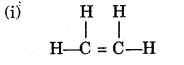
(b) Compound A is bubbled through bromine dissolved in carbon tetrachloride and the product is CH2Br – CH2Br.

ICSE Chemistry Question Paper 2010 Solved for Class 10 - 13
(i) Draw the structural formula of A.
(ii) What type of reaction has A undergone?
(iii) What is your observation?
(iv) Name (not formula) the compound formed when steam reacts with A in the presence of phosphoric acid.
(v) What is the procedure for converting the product of (b) (iv) back to A? [5]

Answer:
(a)
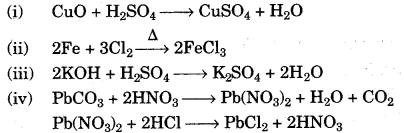
ICSE Chemistry Question Paper 2010 Solved for Class 10 - 14

(b)

ICSE Chemistry Question Paper 2010 Solved for Class 10 - 15
(ii) Addition reaction
(iii) Brown colour of bromine decolourized
(iv) Ethanol/Ethyl alcohol
(v) Dehydration.

Question 7:
(a) The diagram shows a simple arrangement of the fountain experiment:
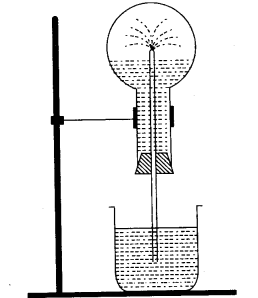
ICSE Chemistry Question Paper 2010 Solved for Class 10 - 16

  1. Name the two gases you have studied which can he used in this experiment.
  2. What is the common property demonstrated by this experiment? [3]

(b) Define the followig terms:

  1. Ionization potential.
  2. Electron affinity.     [2]

(c) The action of heat on the blue crystaline solid L gives a reddish brown gas M, a gas which re-lights a glowing splint and leaves a black residue. When gas N, which has a rotten egg smell, is passed through a solution of L a black precipitate is formed.
(i) Identify L, M and N (Name or formula)
(ii) Write the equation for the action of heat on L.
(iii) Write the equation for the reaction between the solution of L and the gas N. [5]

Answer:
(a)

  1. Ammonia gas and Hydrogen chloride gas.
  2. High solubility of the gases in water.

(b)

  1. Ionization potential is defined as the energy required to remove an electron from a neutral isolated gaseous atom to convert it into a positively charged gaseous ion.
  2. Electron affinity is the amount of energy released. While converting a neutral gaseous isolated atom into a negatively charged gaseous ion when an extra gaseous electron is added to the atom.

(c)

ICSE Chemistry Question Paper 2010 Solved for Class 10 - 17

ICSE Chemistry Question Paper 2011 Solved for Class 10


ICSE Paper 2011

CHEMISTRY

(Two Hours)
Answers to this Paper must be written on the paper provided separately.
You will not be allowed to write during the first 15 minutes.
This time is to be spent in reading the Question Paper.
The time given at the head of this Paper is the time allowed for writing the answers.
Section I is compulsory. Attempt any four questions from Section II.
The intended marks for questions or parts of questions are given in brackets [ ].

SECTION-I  (40 Marks)
(Attempt all questions from this Section)

Question 1:
(a) Choose from the following list of substances, as to what matches the description from (i) to (v) given below:
[Acetylene gas, aqua fortis, coke, brass, barium chloride, bronze, platinum].

  1. An aqueous salt solution used for testing sulphate radical.
  2. A catalyst used in the manufacture of nitric acid by Ostwald’s process.
  3. A black powdery substance used for the reduction of zinc oxide during its extraction.
  4. A gaseous hydrocarbon commonly used for welding purposes.
  5. The substance is an alloy of zinc, copper and tin.      [5]

(b) What would you observe in each of the following cases?

  1. Ammonium hydroxide is first added in a small quantity and then in excess to a solution of copper sulphate.
  2. Sugar crystals are added to a hard glass test tube containing concentrated sulphuric acid.
  3. Copper is heated with concentrated nitric acid in a hard glass test tube.
  4. Water is added to the product formed, when aluminium is burnt in a jar of nitrogen gas.
  5. When carbon monoxide is passed over heated copper oxide. [5]

(c) Give reasons as to why:

  1. The electrolysis of acidulated water is considered to be an example of catalysis.
  2. Almost 90% of all known compounds are organic in nature.
  3. It is dangerous to burn methane in an insufficient supply of air.
  4. Hydrogen chloride can be termed as a polar covalent compound.
  5. The oxidising power of elements increases on moving from left to right
    along a period in the periodic table.     [5]

(d) Fill in the blanks from the choices given below:       [5]

  1. In covalent compounds, the bond is formed due to the ……….. (sharing /transfer) of electrons.
  2. Electrovalent compounds have a …………. (low/high) boiling point.
  3. A molecule of …………. contains a triple bond (hydrogen, ammonia, nitrogen).
  4. Across a period, the ionization potential …………… (increases, decreases, remains same).
  5. Down the group, electron affinity ……………. (increases, decreases, remains same). [5]

(e)

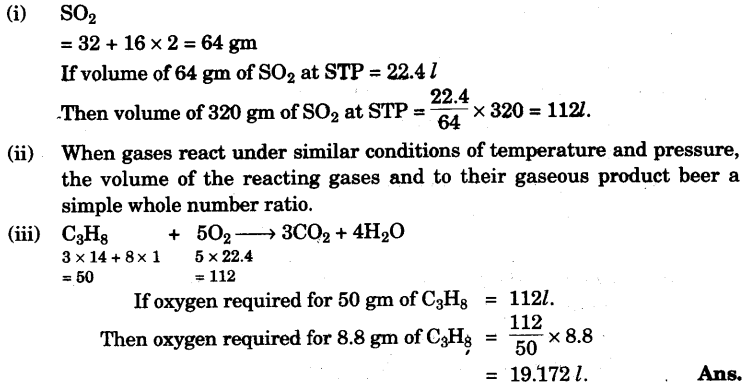
(i) Calculate the volume of 320 g of SO2 at stp. (Atomic mass: S = 32 and O = 16).
(ii) State Gay-Lussac’s Law of combining volumes.
(iii) Calculate the volume of oxygen required for the complete combustion of 8.8 g of propane (C3H8). (Atomic mass: C = 14, O = 16, H = 1, Molar Volume 22.4 dm3 at stp). [5]

(f) Choose the correct answer from the options given below: [10]

  1. This metal is a liquid at room temperature.
    (A) Potassium      (B) Zinc
    (C) Gold                 (D) Mercury
  2. Hydroxide of this metal is soluble in sodium hydroxide solution:
    (A) Magnesium   (B) Lead
    (C) Silver              (D) Copper
  3. In the periodic table alkali metals are plowed in the group ……..
    (A) 1          (B) 11
    (C) 17        (D) 18
  4. Hydrogen chloride gas being highly soluble in water is dried by:
    (A) Anhydrous calcium chloride (B) Phosphorous penta oxide
    (C) Quick lime                                 (D) Concentrated sulphuric acid
  5. The brown ring test is used for detection of:
    (A) CO32-        (B) NO3
    (O SO32-        (D) Cl
  6. When dilute sulphuric acid reacts with iron sulphide, the gas evolved is ……….
    (A) Hydrogen sulphide   (B) Sulphur dioxide
    (C) Sulphur trioxide        (D) Vapour of sulphuric acid
  7. The functional group present in acetic acid is:
    (A) Ketonic C = 0 (B) Hydroxyl —OH
    (C) Aldehydic —CHO (D) Carboxyl —COOH
  8. The unsaturated hydrocarbons undergo:
    (A) a substitution reaction      (B) an oxidation reaction
    (C) an addition reaction           (D) none of the above
  9. The number of C-H bonds in ethane molecule are:
    (A) Four         (B) Six
    (C) Eight        (D) Ten
  10. Which of the following properties do not match with elements of the halogen family?
    (A) They have seven electrons in their valence shell.
    (B) They are highly reactive chemically.
    (C) They are metallic in nature.
    (D) They are diatomic in their molecular form.

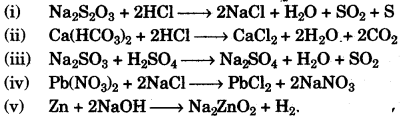
(g) Write the balanced chemical equation for each of the following reactions:  [5]

(i) Sodium thiosulphate is reacted with dilute hydrochloric acid.
(ii) Calcium bicarbonate reacts with dilute hydrochloric acid.

(iii) Dilute sulphuric acid is poured over sodium sulphite.

(iv) Lead nitrate solution is added to sodium chloride solution.
(v) Zinc is heated with sodium hydroxide solution.

Answer:
(a)

  1. Barium chloride
  2. Platinum
  3. Coke
  4. Acetylene gas
  5. Bronze

(b)

  1. In small quantity — a bluish white ppt is obtained.
    In excess — deep (inky) blue solution is obtained.
  2. Turns to black mass called sugar charcoal.
  3. A reddish brown acidic gas called nitrogen dioxide is obtained.
  4. Pungent smelling basic gas called ammonia is evolved.
  5. Reddish metal copper is obtained.

(c)

  1. Sulphuric acid catalyses the ionisation of water because distilled water is a poor conductor of electricity and does not form ions.
  2. They all contains carbon as an essential component.
  3. It leads to incomplete combustion releasing carbon monoxide which is extremely poisonous and cause death.
  4. Difference between electronegativities of H and Cl is high. E.N. of Cl is much higher than that E.N. of H. So a unidirectional pull towards Cl will be created leading to polarity.
  5. Oxidising power means tendency to make the other element get oxidised which increases with increase in non metallic nature. From left to right in a period the non metallic nature increases.

(d)

  1. sharing
  2. high
  3. nitrogen
  4. increases
  5. decreases

(e)

ICSE Chemistry Question Paper 2011 Solved for Class 10 - 1
(f)

  1. (D)
  2. (B)
  3. (A)
  4. (D)
  5. (B)
  6. (A)
  7. (D)
  8. (C)
  9. (B)
  10. (C)

(g)

ICSE Chemistry Question Paper 2011 Solved for Class 10 - 23

SECTION-II (40 marks)
(Answer any four questions from this section)

Question 2:
(a) Differentiate between electrical conductivity of copper sulphate solution and copper metal. [3]
(b) Sodium hydroxide solution is added to the solutions containing the ions mentioned in List X. List Y gives the details of the precipitate. Match the ions with their coloured precipitates. [3]

List XList Y
1. Pb2+A. Reddish brown
2. Fe2+B. White insoluble in excess
3. Zn2+C. Dirty green
4. Fe3+D. White soluble in excess
5. Cu2+E. White soluble in excess
6. Ca2+F. Blue

(c) During the electrolysis of copper (II) sulphate solution using platinum as cathode and carbon as anode:
(i) What do you observe at the cathode and at the anode? [1]
(ii) What change is noticed in the electrolyte? [1]
(iii) Write the reactions at the cathode and at the anode. [2]

Answer:
(a) During electrical conductivity of copper sulphate solution, the CuSO4 splits into Cu++ and SO4– – ions. Where as copper metal only conducts electricity but does not undergo any change.

(b)

List XList Y
1. Pb2+D. White soluble in excess
2. Fe2+C. Dirty green
3. Zn2+E. White soluble in excess
4. Fe3+A. Reddish brown
5. Cu2+F. Blue
6. Ca2+B. White insoluble in excess

(c)

(i) Red metal copper deposits at cathode and colourless odourless gas oxygen at Anode.
(ii) The blue colour of copper sulphate solution soon fades.
ICSE Chemistry Question Paper 2011 Solved for Class 10 - 3

Question 3:
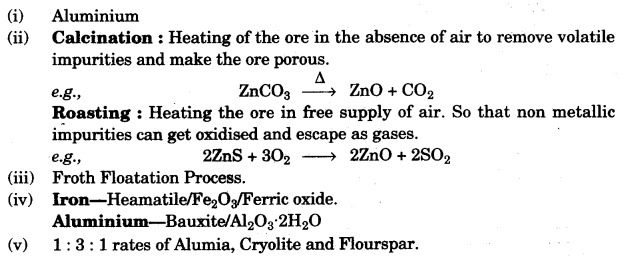
(a) Answer the following questions:

(i) Name a metal which is found abundantly in the earth’s crust.
(ii) What is the difference between calcination and roasting?
(iii) Name the process used for the enrichment of sulphide ore.
(iv) Write the chemical formulae of one main ore of iron and aluminium.
(v) Write the constituents of electrolyte for the extraction of aluminium. [5]

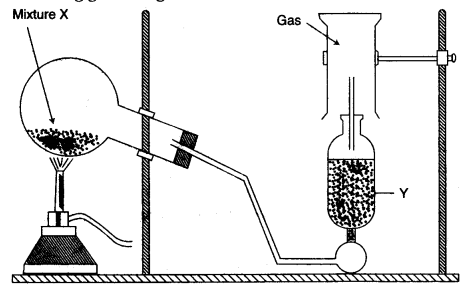
(b) The diagram shows an experimental set up for the laboratory preparation of a pungent smelling gas. The gas is alkaline in nature.
ICSE Chemistry Question Paper 2011 Solved for Class 10 - 4
(i) Name the gas collected in the jar.
(ii) Write the balanced equation for the above preparation.
(iii) How is the gas being collected?
(iv) Name the drying agent used.
(v) How will you find that the jar is full of gas?        [5]

Answer:
(a)

ICSE Chemistry Question Paper 2011 Solved for Class 10 - 5

(b)

(i) Ammonia
ICSE Chemistry Question Paper 2011 Solved for Class 10 - 6
(iii) Downward displacement of air.
(iv) Quick lime/CaO.
(v) Bring a moist red litmus paper to the mouth of the inverted jar if it immediately turns blue.
Or
Bring a glass rod dipped in hydrochloric acid to the mouth of the inverted jar, if it produces dense white fumes. The gas jar is full of gas.

Question 4:
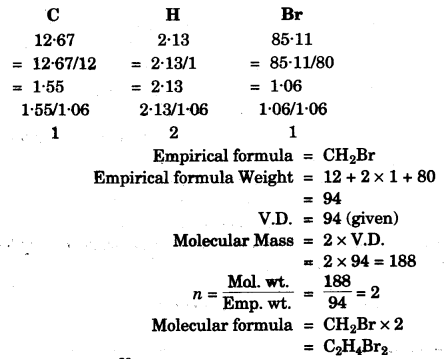
(a) An organic compound with vapour density = 94 contains
C = 12.67%, H = 2.13% and Br = 85.11%. Find the molecular formula.
[Atomic mass: C = 12, H = 1, Br = 80]     [3]

(b) Calculate the mass of:
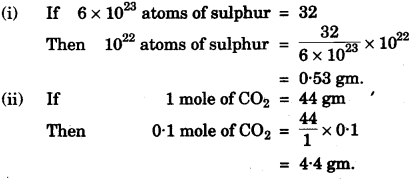
(i) 1022 atoms of sulphur.
(ii) 0.1 mole of carbon dioxide.
[Atomic mass: S = 32, C = 12 and O = 16 and Avogadro’s Number = 6 × 10²³]    [2]

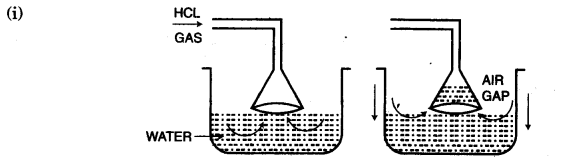
(c) In the laboratory preparation of hydrochloric acid, HCl gas is dissolved in water.
(i) Draw a diagram to show the arrangement used for the absorption of HCl in water.
(ii) Why is such an arrangement necessary? Give two reasons.
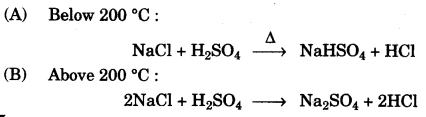
(iii) Write the chemical equations for the laboratory preparation of HCl gas when the reactants are:
(A) below 200 °C (B) above 200 °C.       [5]

Answer:
(a)
ICSE Chemistry Question Paper 2011 Solved for Class 10 - 7
(b)

ICSE Chemistry Question Paper 2011 Solved for Class 10 - 8
(c)

ICSE Chemistry Question Paper 2011 Solved for Class 10 - 9
(ii) HCl gas is highly soluble in water almost at the ratio of 1 : 450. So HCl gas undergoes back suction due to which the source of HCl will be affected.
ICSE Chemistry Question Paper 2011 Solved for Class 10 - 10

Question 5:
(a) Choose the correct word I phrase from within the brackets to complete the following sentences:

(i) The catalyst used for conversion of ethene to ethane is commonly …………… (nickel / iron / cobalt)
(ii) When acetaldehyde is oxidized with acidified potassium dichromate, it forms ………….. (ester / ethanol / acetic acid)
(iii) Ethanoic acid reacts with ethanol in presence of concentrated H2SO4 so as to form a compound and water. The chemical reaction which takes place is called …………… (dehydration/hydrogenation/esterification)
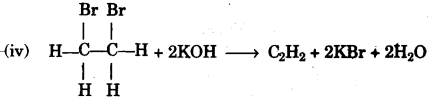
(iv) Write the equation for the reaction taking place between 1, 2-dibromethane and alcoholic potassium hydroxide.
(v) The product formed when ethene gas reacts with water in the presence of sulphuric acid is ………….. (ethanol / ethanal / ethanoic acid) [5]

(b) Write balanced chemical equations for the following:

(i) Monochloro ethane is hydrolysed with aqueous KOH.
(ii) A mixture of sodalime and sodium acetate is heated.
(iii) Ethanol under high pressure and low temperature is treated with acidified potassium dichromate.
(iv) Water is added to calcium carbide.
(v) Ethanol reacts with sodium at room temperature. [5]

Answer:
(a)

(i) Nickel
(ii) Acetic acid
(iii) Esterification
ICSE Chemistry Question Paper 2011 Solved for Class 10 - 11
(v) Ethanol.

(b)
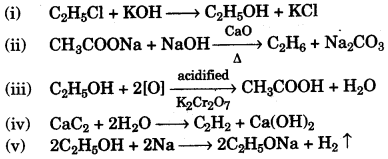
ICSE Chemistry Question Paper 2011 Solved for Class 10 - 12

Question 6:
(a) (i) With the help of equations, given an outline for the manufacture of sulphuric acid by the contact process.
(ii) What property of sulphuric acid is shown by the reaction of concentrated sulphuric acid when heated with:
(A) potassium nitrate (B) carbon [5]

(b) (i) What is the special feature of the apparatus that is used in the laboratory preparation of nitric acid?
(ii) Why should the temperature of the reaction mixture of nitric acid not be allowed to rise above 200 °C? [2]

(c) Write balanced chemical equations for the following:
(i) Chlorine reacts with excess of ammonia.
(ii) Ferric hydroxide reacts with nitric acid.
(iii) Zinc oxide dissolves in sodium hydroxide. [5]

Answer:
(a)
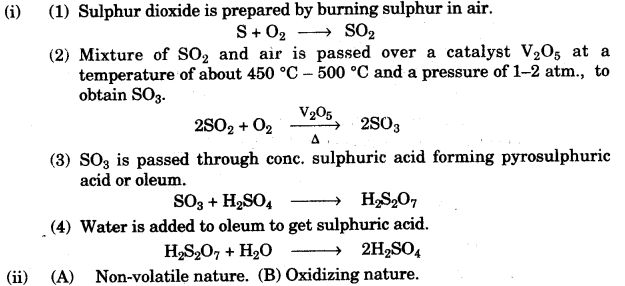
ICSE Chemistry Question Paper 2011 Solved for Class 10 - 13

(b)

(i) An all glass apparatus is used because nitric acid is highly corosive in nature and will damage wood, metal, rubber, plastic etc.
(ii)

  1. Above 200 °C the nitric acid decomposes into H2O, NO2 and O2 as it is very unstable to heat.
  2. Sodium sulphate or potassium sulphate will be formed which forms a crust over the mixture thus restricting the release of nitric acid vapours.

(c)
ICSE Chemistry Question Paper 2011 Solved for Class 10 - 14

Question 7:
(a) (i) Give the number of the group and the period, of the element having three shells with three electrons in valence shell.
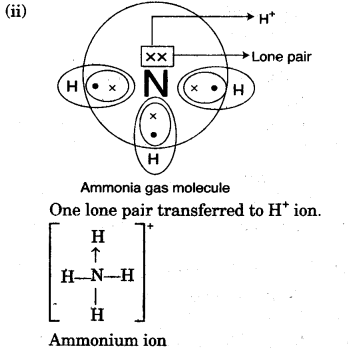
(ii) By drawing an electron dot diagram, show the lone pair effect leading to the formation of ammonium ion from ammonium gas and hydrogen ion.
(iii) What happens to the crystals of washing soda when exposed to air? Name the phenomenon exhibited. [5]

(b) Name the method used for preparation of the following salts from the list given below:  [5]
(i) Sodium nitrate         (ii) Iron (III) chloride.
(iii) Lead chloride         (iv) Zinc sulphate           (v) Sodium hydrogen sulphate.
List:
(A) Simple displacement        (B) Neutralization
(C) Decomposition by acid    (D) Double decomposition    (E) Direct synthesis

Answer:
(a)

(i) Period number = 3
Group number = 13/III A.
ICSE Chemistry Question Paper 2011 Solved for Class 10 - 15
(iii) The crystals of washing soda when exposed to air, it loses its water of crystallisation crystals crumbles down to form white powder.
The phenomenon is called Efflorescence.

(b)

(i) Sodium nitrate — (B) Neutralisation.
(ii) Iron (III) chloride — (E) Direct Synthesis.
(iii) Lead chloride — (D) Double decomposition
(iv) Zinc sulphate — (A) Simple displacement.
(v) Sodium hydrogen sulphate — (C) Decomposition by acid.

Contact Us

Sponsered Site :

https://www.sdaschooltambaram.com/

Address :

Tambaram, chennai - 45
Tamilnadu

Email :

sdaschooltambaram45@gmail.com